Wednesday, October 22, 2014

PERGAMON and NEUES MUSEUM Berlin, Germany

   One of the most popular attractions in Berlin, the Pergamon Museum is world famous for its archaeological holdings. The Pergamon, located on Museum Island, is really three museums in one – the Collection of Classical Antiquities (also on display in the Old Museum), the Museum of the Ancient Near East, and the Museum of Islamic Art.
  It is breathtaking, seeing this huge facade...'can't resist using my 'human tripod'  to take pictures of me ... This is an added list of my favorite museums.
    The Ishtar Gate was the eighth gate to the inner city of Babylon. It was constructed in about 575 BC by order of King Nebuchadnezzar II on the north side of the city.


   The gate is decorated with dragons, lions and bulls, symbolizing the major gods of Babylon; a transparent back wall lets visitors see how the massive gate was reconstructed from fragments.


Market Gate of Miletus
    The Market Gate of Miletus is a large marble monument in the Pergamon Museum in Berlin, Germany. It was built in Miletus in the 2nd century AD and destroyed in an earthquake in the 10th or 11th century.


     The gate was built in the 2nd century AD, most likely during the reign of Emperor Hadrian about 120 to 130 AD.It replaced an existing Doric propylon and served as the northern entrance to the southern market, or agora, in Miletus, an ancient city in what is now Turkey.The gate underwent restoration in the 3rd century following damage from an earthquake. When Justinian strengthened the defenses of Miletus in 538, the gate was incorporated into the city walls. In the 10th or 11th century, an earthquake caused the gate to collapse. Fragments of the structure were scavenged and used in surrounding buildings, but the majority subsided into the ground.

 Zooming in on the column...


.


       The Museum of Islamic Art was started in 1904 with a donation of precious carpets by Wilhelm von Bode. Such textiles still make up a major part of the exhibition, with colourful examples from Iran, Asia Minor, Egypt and the Caucuses on view.
   I can't resist taking his picture...


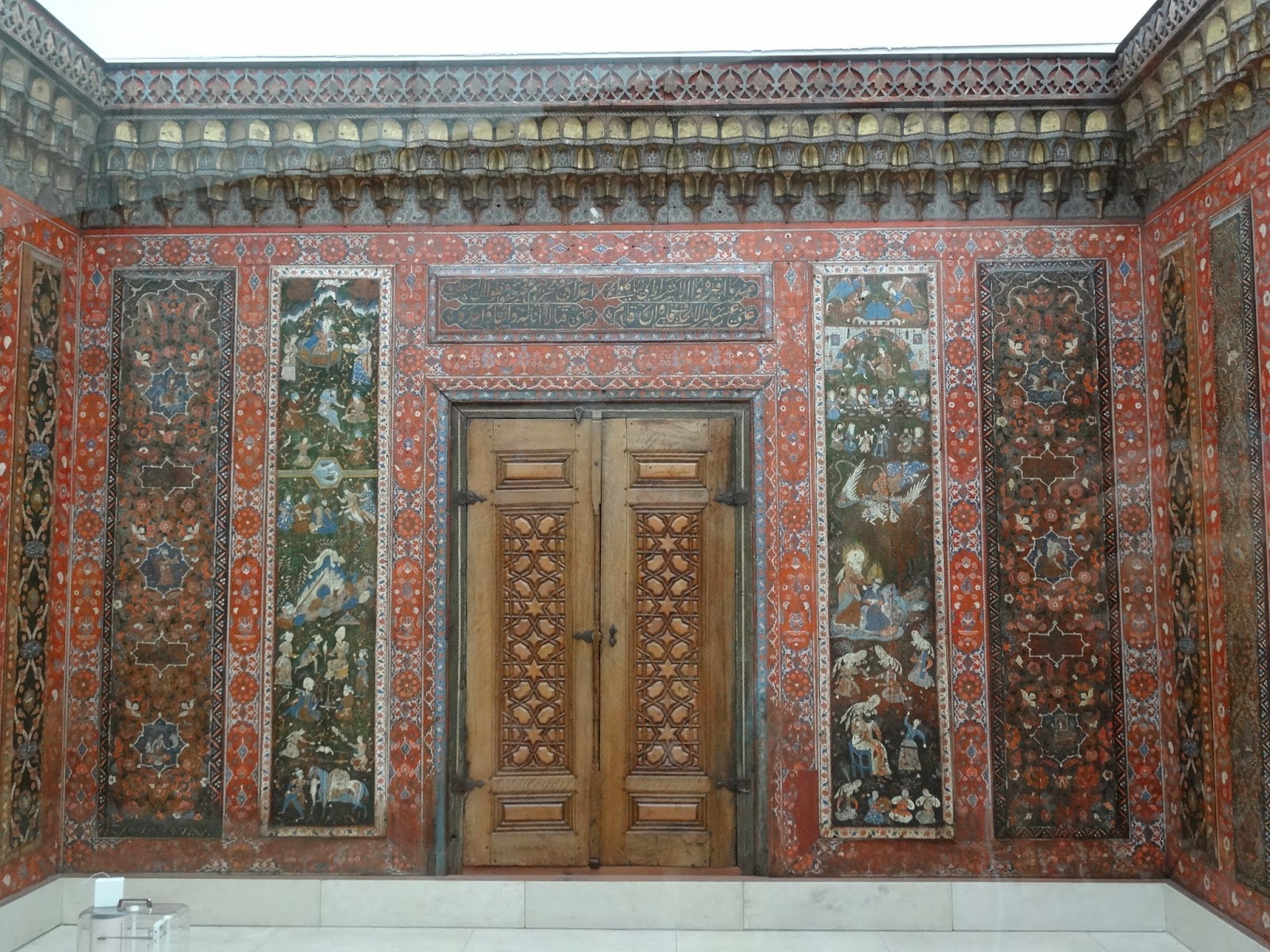
      Highlights from the collection of 8th – 19th century Islamic art and craft include the 17th century Aleppo Zimmer, a vividly coloured panelled room from a merchant’s house in the Syrian city of Aleppo that is painted with Arabian and Persian verses and sayings and pictures of people, plants, and mythical beings
   Visitors are not allowed to get inside...this is housed in a glass room....


NEUES MUSEUM
      The Neues Museum houses the archaeological collections of the Egyptian Museum and Papyrus Collection, the Museum of Pre- and Early History, as well as works from the Collection of Classical Antiquities.

Did you post on my wall??  :)


    The building was left abandoned for decades, and restoration was only decided upon in 1985. Since 1997, British architect David Chipperfield has been charged with overseeing the renovation of the building as part of a general restoration of the entire Museum Island, which runs until 2015.


     The Neues Museum once again houses the archaeological collections of the Egyptian Museum and Papyrus Collection, the Museum of Pre- and Early History, as well as works from the Collection of Classical Antiquities.
   These collections really caught my eye...


     The most prominent feature of the exhibit, the bust of Egyptian Queen Nefertiti, described as “the world’s most beautiful woman,” is centrally and prominently displayed in the north cupola of the building.
   Sorry...cameras are not allowed...so I just got this picture from Wikipedia...I'd say, she is the Mona Lisa of the Middle East...she must have been beautiful in person.

    I only saw and read these on books...but now, I have the opportunity to see the papyrus, mummy tombs (once again--the first time was in London), ....................a blessing indeed...


      Trying to educate myself through this headset...lol...

Sit...kitty,...sit still......


thank you---------------- danke...................

---- yours truly,  Freundschaft Bee........

Monday, October 20, 2014

BERLIN WALL..... Berlin, Germany

A Symbol of Cold War
 Berliner Mauer (In German)
Dates: August 13, 1961 -- November 9, 1989

   What Was the Berlin Wall?
The Berlin Wall was both the physical division between West Berlin and East Germany from 1961 to 1989 and the symbolic boundary between democracy and Communism during the Cold War.


     The Berlin Wall was erected in the dead of night and for 28 years kept East Germans from fleeing to the West. Its destruction, which was nearly as instantaneous as its creation, was celebrated around the world.


    By the late 1950s, many people living in East Germany wanted out. No longer able to stand the repressive living conditions of East Germany, they would pack up their bags and head to West Berlin.
----Wall with graffiti is on the West Side...


    East Germany desperately needed to stop this mass exodus. The obvious leak was the easy access East Germans had to West Berlin. With the support of the Soviet Union, there had been several attempts to simply take over West Berlin in order to eliminate this exit point.

---Wall with nothing written on it, is on the East Side...


 The Berlin Wall Memorial is a reminder for the division of Germany and imparts an oppressive impression of the Wall and the times of the division. 

  Documentation Centre


    The viewable exhibit in the Documentation Centre shows the 1961 history of the Wall’s construction and the circumstances of the divided city. From the tower, one has an impressive view of the preserved parts of the border facility and the memorial in memory of the division of the city and the victims of communist tyranny. 


   An outdoor exhibition by the Berlin Wall Memorial is being laid out here. Using the many historical fragments still found here and the area's eventful past, the exhibition uses concrete examples to describe the purpose and function of the Berlin Wall. It concentrates especially on the stories of people whose lives were disrupted or restricted by the Wall, who were expelled from their homes because of it, or who attempted to escape over it.


   The Reconciliation Church was located at this site, which was blown-up in 1985, as it stood right on the no man’s land “death strip”. After the fall of the Wall, the Chapel of Reconciliation was erected on the foundations as an oval rammed earth building with a wood lamellar casing. The victims of the Wall are regularly remembered during church services. 


 EAST  SIDE  GALLERY  BERLIN
 101 large format images painted directly on the wall are for the joy of came down of the wall , for the overcoming of the Iron Curtain in Europe, the euphoria over the peace -won freedom of the persecution, spying and lack of freedom, the hope for a better, more human society. For personal stories, hopes and dreams .  I took these while on a moving bus.....


   The East Side Gallery is understood as a monument to the fall of the Berlin Wall and the peaceful resolution of boundaries and conventions between companies and people. More than 3 million visitors come to the East Side Gallery every year. In addition, the East Side Gallery is still the only authentic monument of reunification for over twenty years.

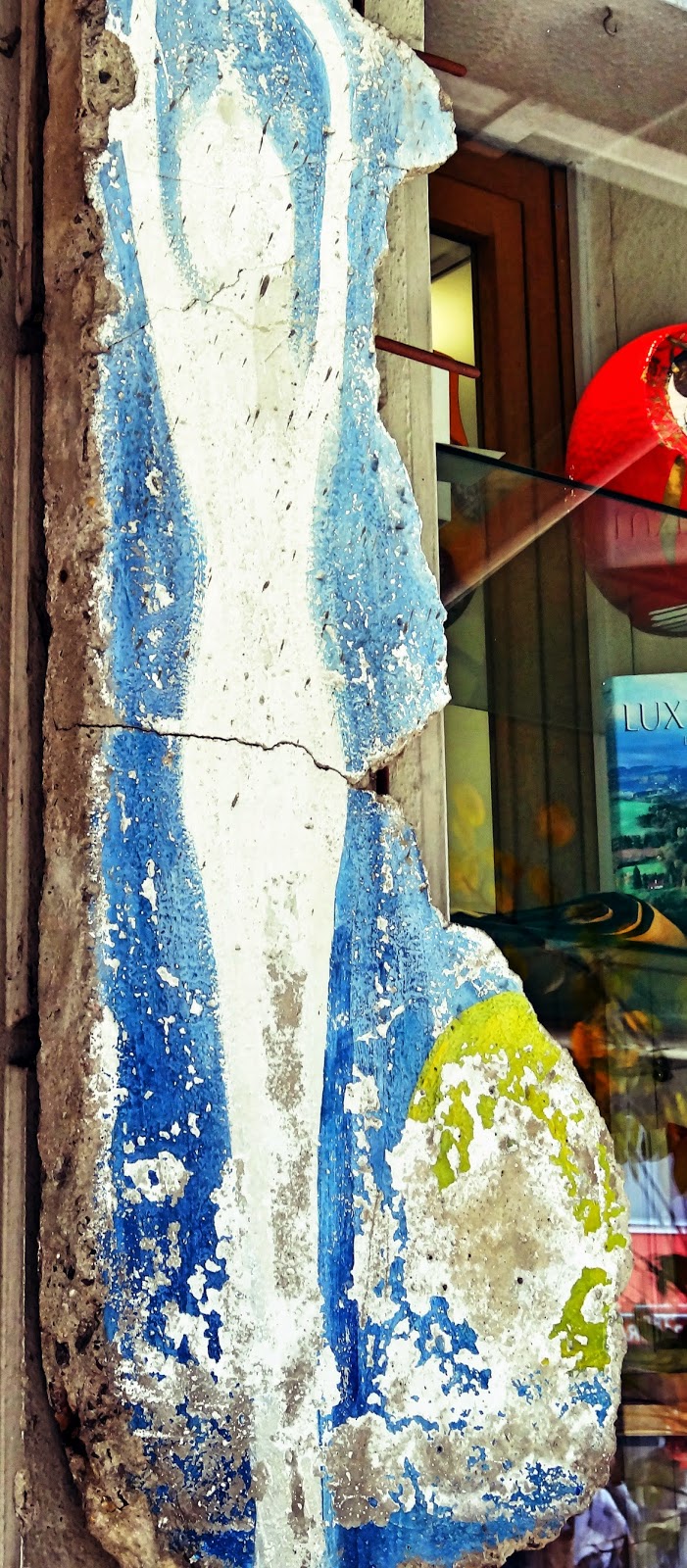
   How about a closer look at these 'chipped' off wall that made it into an art...


Here's a video I took, as we rode the bus...


“Everybody ought to have a lower East Side in their life.”


"Here in Berlin, one cannot help being aware that you are the hub around which turns the wheel of history. ... If ever there were a people who should be constantly sensitive to their destiny, the people of Berlin, East and West, should be they."